

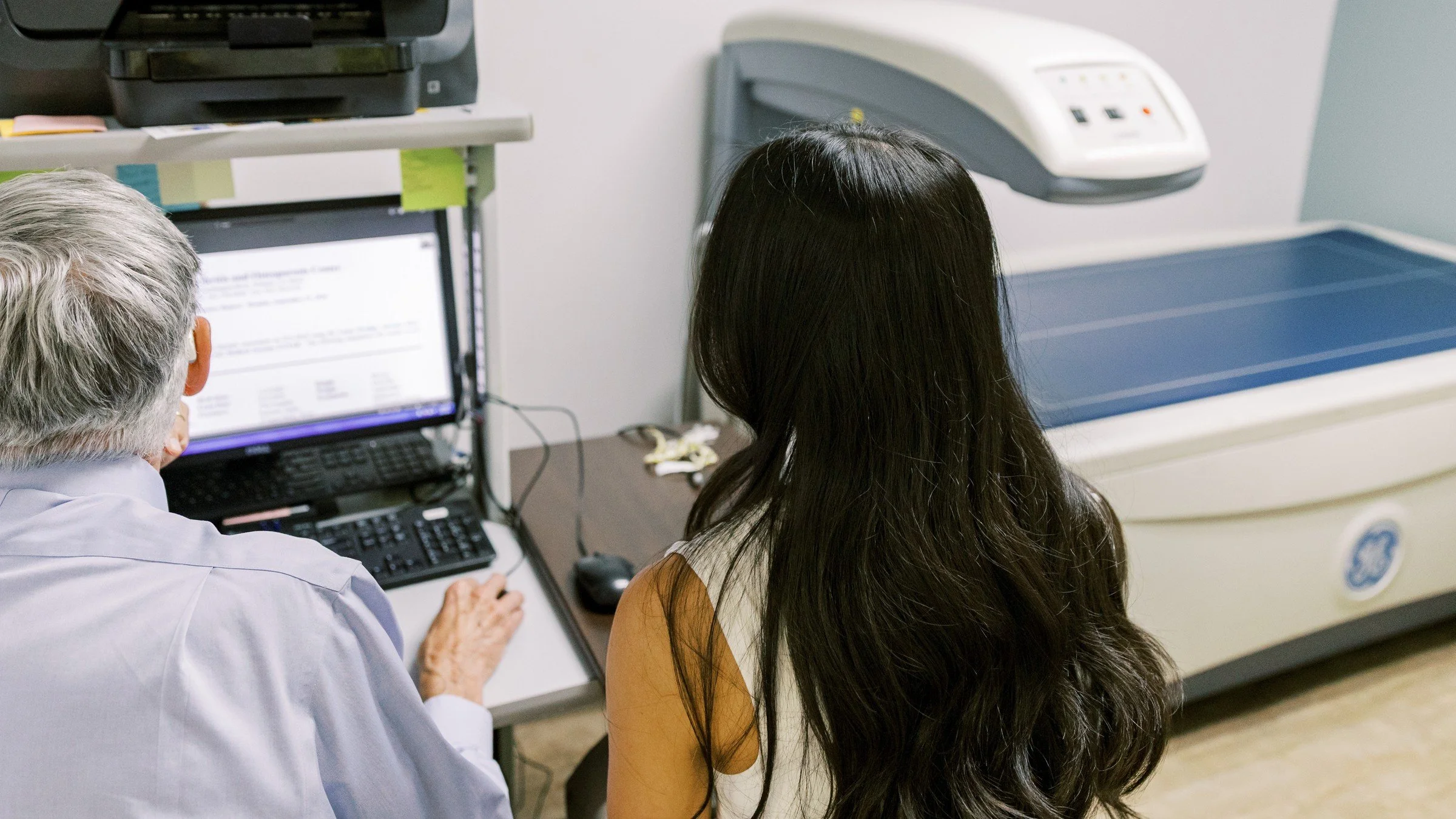
Physician and patient reviewing a bone density scan next to the DEXA scanner at Amicus Arthritis & Osteoporosis Center in Whittier.
Osteopenia and osteoporosis are two points on the same scale. Both mean your bones are less dense than a healthy young adult’s, and the difference is how far below: a T-score between -1.0 and -2.5 is osteopenia, and -2.5 or lower is osteoporosis. Osteopenia is not a diagnosis that always needs medicine, and osteoporosis is not a sentence. What matters most is your actual risk of breaking a bone, which depends on more than one number. Here is how to read your DEXA report, when osteopenia does need treatment, and what you can do now. At Amicus, we do the DEXA scan in our Whittier office and go over your T-score with you the same day.
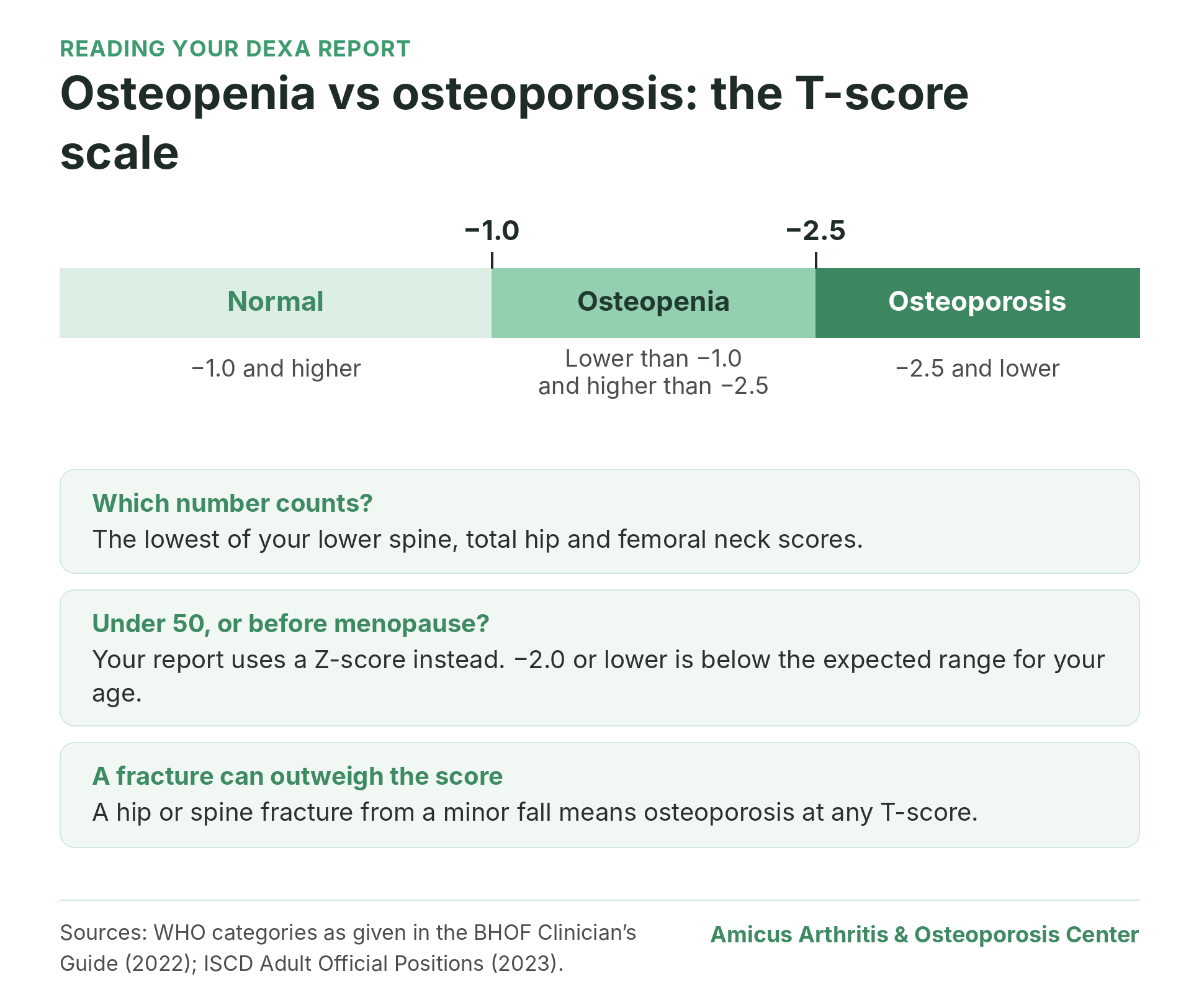
Where osteopenia and osteoporosis fall on the T-score scale.
Osteopenia vs osteoporosis: the short answer
A DEXA (dual-energy X-ray absorptiometry) scan compares your bone density with that of a healthy young adult. The result is your T-score, and the World Health Organization categories are:
Normal: -1.0 or higher.
Osteopenia (low bone mass): lower than −1.0 but higher than −2.5.
Osteoporosis: -2.5 or lower.
The lower the number, the thinner the bone and the higher the fracture risk. Note the wording: osteoporosis starts at -2.5 itself, not just below it.
How to read the T-score on your DEXA report
Your report usually lists several numbers, for the lower spine, the total hip and the femoral neck (the top of the thigh bone). According to the International Society for Clinical Densitometry, the lowest of those is the one used for your diagnosis. So if your spine reads -1.8 and your femoral neck reads -2.6, the result is osteoporosis.
These categories are meant for women after menopause and men 50 and older. Younger adults get a Z-score instead, which compares you with people your own age and sex. A Z-score of -2.0 or lower means your bone density is below the expected range for your age, which is a reason to look for a cause, such as a medication or another medical condition. The National Institutes of Health explains both scores in more detail.
Is osteopenia a disease, and which is worse?
Osteoporosis is the more serious of the two, because the bone is thinner and breaks more easily. Osteopenia is better thought of as a warning sign than a disease. Bone density specialists now prefer the terms “low bone mass” or “low bone density,” and they stress that people with low bone mass are not necessarily at high risk of a fracture.
That said, osteopenia should not be ignored. Far more people have osteopenia than osteoporosis, and the Bone Health & Osteoporosis Foundation estimates that about 44 million Americans age 50 and older have low bone density, alongside about 10 million with osteoporosis. In the large National Osteoporosis Risk Assessment study of postmenopausal women, most of the fractures happened in women whose T-scores were above the osteoporosis line. A score in the osteopenia range is the right time to find out your real risk.
When a fracture changes the diagnosis
A broken bone can outweigh the T-score. Under current bone health guidelines:
A hip or spine fracture from a minor fall or no injury at all means osteoporosis, whatever your T-score says.
A wrist, upper arm or pelvis fracture from a minor fall, together with a T-score in the osteopenia range, also counts as osteoporosis.
If you have broken a bone as an adult after a minor fall, tell your doctor and ask about a bone density test, even if you have been told your bones are “only” osteopenic.
Does osteopenia need treatment? FRAX helps decide
For osteopenia, the decision about medicine comes from your 10-year fracture risk, not the T-score alone.
We calculate it with FRAX, a tool that combines your bone density at the femoral neck (the top of the thigh bone) with your age, sex, weight, height, alcohol, a parent’s hip fracture, past fractures and certain medical conditions.
The Bone Health & Osteoporosis Foundation clinician’s guide recommends considering medicine for postmenopausal women and men 50 and older with osteopenia when FRAX shows:
A 10-year risk of a hip fracture of 3% or higher, or
A 10-year risk of a major osteoporotic fracture (hip, spine, wrist or upper arm) of 20% or higher.
Two of the risk factors built into FRAX are especially relevant in a rheumatology practice: rheumatoid arthritis and taking prednisone or a similar steroid (5 mg a day or more for over three months). If you have either, your fracture risk can be higher than your T-score suggests, which is one reason rheumatologists keep a close eye on bone health.
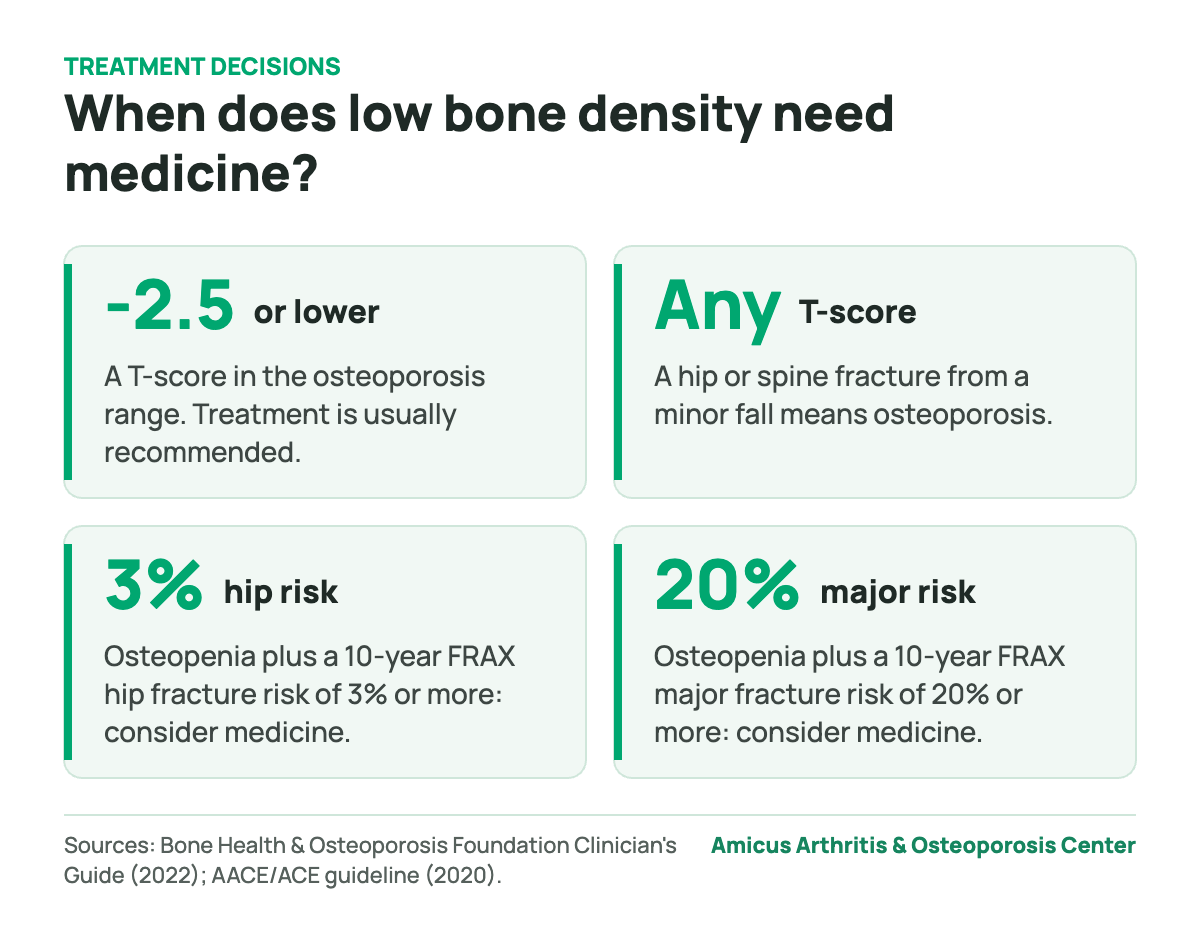
For osteopenia, your 10-year fracture risk, not the T-score alone, decides whether medicine makes sense.
If medicine is recommended, the options include weekly or monthly pills, a once-a-year IV infusion, a twice-a-year injection, and medicines that build new bone for people at the highest risk. Our osteoporosis doctors in Whittier walk you through each one.
Have a DEXA report and not sure what it means? Bring it in. We will go over every number, calculate your fracture risk and explain your options in one visit. Call (562) 758-6600 or request an appointment online.
Can osteopenia be reversed?
Sometimes. Some people move back into the normal range, and many more hold steady for years. Small changes between scans can also be normal measurement variation, so your doctor looks at the trend over time, not a single number.
Bone loss is a natural part of aging, but it can be slowed. When medicine is needed, it lowers fracture risk substantially, and the goal is fewer broken bones, not a perfect number on the report. Be wary of any product that promises to reverse osteopenia through diet or supplements alone.
Calcium, vitamin D and exercise for osteopenia
These are the foundation whether or not you take medicine. Daily amounts from the National Institutes of Health:
Calcium: 1,000 mg a day for men up to 70 and women up to 50. 1,200 mg a day for women 51 and older and for everyone 71 and older. Aim to get it from food first, and use a supplement only to make up the shortfall.
Vitamin D: 600 IU a day up to age 70 and 800 IU from 71. Bone specialists often suggest 800 to 1,000 IU a day after 50, and we may check your blood level.
Exercise: weight-bearing activity such as brisk walking, stair climbing or dancing, plus strength training with weights or resistance bands. A combination is best. If you have low bone density, check with your doctor before starting a new program.
Habits: stop smoking, keep alcohol modest, and make your home safer from falls.
More calcium is not better. Calcium supplements beyond what you need can raise the risk of kidney stones in some people, so get most of your calcium from food and check with us before adding a supplement.
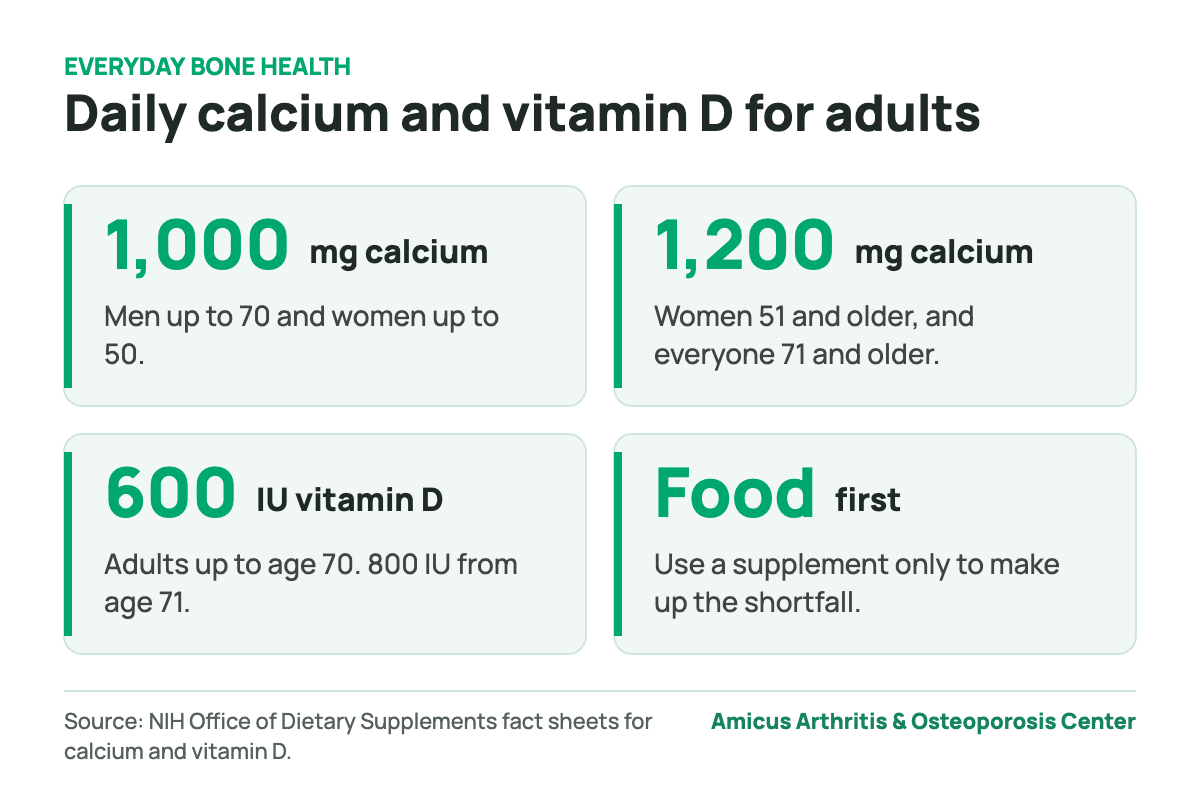
Daily calcium and vitamin D amounts from the National Institutes of Health.
How often should you repeat a bone density scan?
There is no single rule. It depends on how close your T-score is to -2.5, your other risk factors and whether you are on treatment. People who start or change an osteoporosis medicine are usually rescanned in one to two years. With mild osteopenia and no new risk factors, the gap can be several years. Medicare usually covers a bone density test once every 24 months, or more often when it is medically necessary.
Who should get a bone density test?
The U.S. Preventive Services Task Force recommends a bone density test for all women 65 and older, and for younger women after menopause whose risk is raised, based on a clinical risk assessment that looks at factors like low body weight, a parent who broke a hip, smoking or heavy drinking. Tools such as FRAX or OST can help. It found that the evidence for screening men is not yet settled. The Bone Health & Osteoporosis Foundation recommends testing men at 70, or from 50 with risk factors, and anyone who breaks a bone after 50.
Osteopenia and osteoporosis care in Whittier
Amicus Arthritis & Osteoporosis Center is an independent rheumatology practice at 12456 Washington Blvd in Whittier, serving patients from El Monte, Temple City, Alhambra, Rowland Heights, Diamond Bar, Montebello, Pico Rivera, Downey, Santa Fe Springs, and Norwalk. We do the DEXA scan in our own office, read your T-score the same day and calculate your FRAX risk, so testing and treatment stay with one team. Dr. Gilbert Gelfand is a Certified Clinical Densitometrist.
First time seeing a specialist for your bones? Here is what to expect at your first osteoporosis visit and how an osteoporosis doctor helps prevent fractures. We accept Medicare, most national PPO plans, and many HMO and IPA plans; see the insurance plans we accept. Several of our doctors and most of our staff speak Spanish, Dr. Karleen Su also speaks Mandarin, and Dr. Susan Mansourian speaks Farsi.
Learn more about osteoporosis treatment at Amicus.
Frequently asked questions
Does osteopenia cause pain?
Usually not. Osteopenia has no symptoms you can feel. The first sign is often a fracture after a minor fall, which is why a bone density test matters if you are at risk. Sudden back pain or noticeable loss of height can signal a spinal fracture, so call us if you notice either.
Can osteopenia turn into osteoporosis, and how fast?
It can, and the speed depends on how low your score already is. In a large study of older women, it took more than 15 years for 1 in 10 women with normal bone density or mild osteopenia to develop osteoporosis, but only about a year for 1 in 10 of those already close to -2.5. That is why people near the line are rescanned sooner.
Can men have osteopenia?
Yes. The same T-score categories apply to men 50 and older. Men tend to lose bone later than women, and long-term steroid use, low testosterone and heavy drinking raise the risk.
What is the difference between a T-score and a Z-score?
A T-score compares your bone density with a healthy young adult and is used for women after menopause and men 50 and older. A Z-score compares you with people your own age and sex and is used for younger adults. A Z-score of -2.0 or lower is below the expected range for your age.
Does Medicare cover a bone density test?
Medicare Part B usually covers a bone density test once every 24 months for people who qualify, or more often when it is medically necessary. You typically pay nothing if the provider accepts Medicare assignment.
Call (562) 758-6600 to book a DEXA scan or a bone health visit in Whittier.
This article is for general educational purposes and does not replace personalized medical advice. Talk with your doctor before starting or changing any medication or supplement.